Showing posts with label you can grow that. Show all posts

Thursday, April 05, 2012

Forsythia : You Can Grow That!

I received so many encouraging comments on my "You Can Grow That" post about espalier fruit trees last month, that I have been looking forward to joining C.L. Fornari of Whole Life Gardening, in this month's edition of "You Can Grow That".

At first I planned to write about strawberries in the garden, but I may save that for a future post.  Instead, I have been admiring the cheery yellow blooms of forsythia all around the city, and have chosen that for today's topic.

You can grow forsythia, and if you know of any bushes in your area, you can start your own very economically.  Forsythia cuttings can be easily rooted in water.  So all you need to do is clip a twig or two, and set them in a vase.  Soon they will be sprouting and likely will send out roots.  Once the roots are visible, the forsythia can be planted out into the garden, and will quickly grow into a shrub.  I have a forsythia plant behind my compost boxes (see photo below), which was started this way, a couple of years ago.

Although you can cut a flowering twig, and both enjoy the blooms, and then the greenery which will quickly develop, the best time to take a cutting is once the blooms have disappeared, and the plant is directing its energy into growth.  No growth hormones or special treatment are required.
Although the forsythia naturally grows as a floppy bush, it can be trimmed into a hedge, as I see in many yards.  It can also be grown as a standard.  I discovered a wonderful example some years ago while driving, not far from home, and have a photo somewhere of this wonderful forsythia standard in bloom.  I returned the following year to discover that it was gone, replaced by a very small forsythia twig, which the owner appeared to be training in standard form.  I wondered if the wonderful one I had seen had been damaged, and he/she was starting over, or whether it was so beautiful that someone had bought or relocated it.  I never did find out.

I don't know how much work it would be to trim and train it into standard form, but since it grows quite vigorously and is flexible and easy to trim, I don't imagine it would be difficult, if one had patience to wait for the result.  With some diligence at supporting the stem so that it grows straight, trimming away any other stems or lower branches, and trimming the upper branches into a globular shape, but you should be able to grow that, too.  Some day I want to give it a try.  When I'm ready, I can take a cutting from the bush behind my compost bins.

Sunday, March 04, 2012

Espalier Fruit Trees - You Can Grow That!

I was delighted to discover today the first collaborative posting of the monthly "You Can Grow That" blogging meme series, hosted by C.L. Fornari of Whole Life Gardening, and I knew I had to join.  At least this first one.  I don't know how often I'll remember it's the 4th day of the month, or have something I can organize, but I instantly knew what I wanted to share : my espalier fruit trees.

My espalier fruit trees are a continual delight to me, as well as to my garden and garden blog visitors.  All three are in the horizontal cordon espalier form, and all of them feature 3 different varieties of the same fruit, one on each horizontal level.  I have had my apple and asian pear espaliers about 7 years now, in which time their branches have grown from about 1 1/2 feet long to about 8 feet long.  My european pear is quite new, added only 4 years ago.

Here is my apple espalier tree, with a closeup of 2 of the varieties of apples:

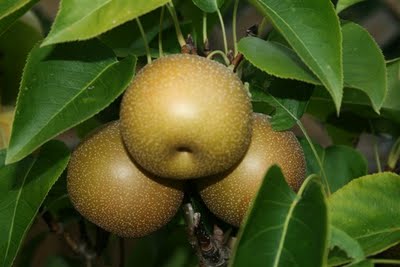
And here is my espalier asian pear, with a closeup of all 3 varieties of asian pears:


For me, the process of planting and getting them set up was an interative approach, but some of the lessons I've learned are :

1. Leave lots of room for horizontal growth of the branches.  I like the look of mine at 8 feet (16 overall), since this is the length of my cedar fence panels.  But I think the branches could easily grow to 12 feet or more, with adequate supports.
2. If you plant against a wall or fence, leave room behind for access.  Mine are planted about 12" from the fence, and this provides good access to reach behind, to trim branches, etc.
3. You don't need a fence behind.  At the UBC Botanical gardens, there are some wonderful examples of espaliers growing beside a path in the food garden, and the espaliers themselves form a fence.  But if you have a fence or wall available, it helps to provide reflective heat for fruit production.
4. Provide adequate supports for the branches.  Mine are a thick vinyl-coated copper wire ( roughly equivalent to a clothesline), tied to landscaping posts through eyelet hooks.  But over time the eyelet hooks are coming loose, so if I re-tied them, I would tie them directly around the posts, and bend a nail over them to keep them from sliding up/down the post.
5. Be diligent in pruning.  Over time you will learn to recognize fruit-bearing spurs (which are compact) and the vertical growth which need to be trimmed back aggressively, to allow the tree to put its energy into fruit rather than branch development.  I prune them at various times during the year, mostly in spring and summer, when the growth is quite vigorous, and needs to be diverted to the fruit.
6. Be diligent in thinning the fruit.  Yes, the fruit is so plentiful, that it needs to be pruned, in order to allow the fruit to develop.  Best not to leave more than one or two per fruiting spur, and not closer than 6" apart.  This is the task I find the hardest, and I tend to leave too much fruit, creating undue strain on the tree, and ending up with fruits that don't ripen as quickly or fully as they could.

But most of all, I've learned with all of my fruit trees :
7. Start now!  Trees are an excellent investment, and grow every year, so if you are thinking about a purchase, don't put it off another year.  Prepare your hole, and head to the nursery!  The best stock arrives (usually bareroot) in late winter/early spring, so it is that time, or soon will be!

PS. Come join in the 4th of each month with your own "You Can Grow That" post, at Whole Life Gardening.
Blog Widget by LinkWithin