Considering we bought our Japanese plum (Methley) tree only three years ago, it provided a good harvest this year. Yesterday, I noticed the plums started disappearing (squirrels!), and falling (squirrels?) to the ground, so I picked most of them, leaving only a half dozen which were not fully ripe (which were already gone today - squirrels!). Here is my harvest :
As the description promised, the plums have "dark red juicy flesh" with "mild and sweet flavour" and it is an "attractive and vigorous tree". It is a truly beautiful tree, and I think I've done a reasonable job of pruning it so far, so it is growing in nicely.
Since the forecast yesterday was for rain, we had postponed our big BBQ for the following week, and then it didn't end up raining at all, so I spent a few good solid hours in the garden. One of my projects was to fight through a solid mat of ornamental grass, which is growing all around my red Japanese maple, so that I can get to a nasty blackberry vine which is growing up from under the tree, and pushing through it for the last few years. After more than an hour of chopping through the grass, I had cleared a path which is close to the blackberry, but removing it, and the grass directly under the tree, will be a job for another day. The path I cleared was more than one wheelbarrow's worth :
Showing posts with label weeds. Show all posts
Sunday, July 20, 2014
Tuesday, May 06, 2008
Garden Glimpses : Early May 2008
Here are a few more recent garden photos (click any photo for a larger image)... Sometimes an accidental pairing can have a pleasing effect, like these tulips blooming among the greenery of an iris. Oh yeah, I planned it that way. ;-)

I believe this is the first time I've seen this rhodo in bloom. Nice.

This is also the first time I have flowers on my Cornus canadensis (Bunchberry, a perennial dogwood groundcover). I'm very pleased, I was worried last year I would lose my few shoots, but it looks as if it's now established.

If dandelion were not so successful here, it would make an ideal flower. Deep-rooted, and such cheery yellow flowers. Look at this one among the rockery, I wished I didn't need to dig it out:

But sadly, I have dandelions by the dozen this year, as well as thousands of Carex pendula, which I am digging out by the wheelbarrow-full. My soil is a very rich garden mix (many, many truckloads of it were brought in to form a garden on top of the impenetrable clay beneath), so everything that lands in it, grows like crazy. If my weeds were edible, many of them would be "entree-sized".

The fruit trees are loaded in blossoms this year. Looking at the other fruit trees in the neighbourhood, it looks like it will be good year for fruit trees, all around. Here is my young bartlett pear tree, showing great promise this year:


Here is my Rainier cherry, about one week ago, in full blossom:

I believe this is the first time I've seen this rhodo in bloom. Nice.

This is also the first time I have flowers on my Cornus canadensis (Bunchberry, a perennial dogwood groundcover). I'm very pleased, I was worried last year I would lose my few shoots, but it looks as if it's now established.

If dandelion were not so successful here, it would make an ideal flower. Deep-rooted, and such cheery yellow flowers. Look at this one among the rockery, I wished I didn't need to dig it out:

But sadly, I have dandelions by the dozen this year, as well as thousands of Carex pendula, which I am digging out by the wheelbarrow-full. My soil is a very rich garden mix (many, many truckloads of it were brought in to form a garden on top of the impenetrable clay beneath), so everything that lands in it, grows like crazy. If my weeds were edible, many of them would be "entree-sized".

The fruit trees are loaded in blossoms this year. Looking at the other fruit trees in the neighbourhood, it looks like it will be good year for fruit trees, all around. Here is my young bartlett pear tree, showing great promise this year:


Here is my Rainier cherry, about one week ago, in full blossom:
Labels:
bunchberry,
flower photos,
fruit trees,
garden glimpses,
tulips,
weeds
Tuesday, February 07, 2006
Weed Management : Ground Fillers
Some of my favourite flowers are perennials which form a sizable mound of foliage at their base. Not only are these attractive, but once established, are effective at blocking weeds.
My new garden still has much spacing between plants, but over the next few years, I plan for them to spread, so that by mid-summer, there is practically no soil showing, and little chance for weeds to propagate or survive. Here are some of my favourite "ground fillers" (weed-busters):
Osteospermum - Forms a wonderful mat of green, which self-roots as it spreads, and has such attractive flowers. Stays green all winter. Read more in my osteospermum post.

Lamb's Ear (Stachys byzantina) - Forms a wonderful fuzzy silver ground-cover, with spikes of purple flowers in the late summer which are not terribly attractive to me, but adored by bees. The leaves are great in dried flower arrangements, and looking remarkably like little lamb's ears, are loved by children (including older children like me!). The flower spikes can be cut down in the Fall, and the leaves remain relatively fresh-looking all winter.
Hardy Geranium
- Although there are some varieties which tend to sprawl, there are many which form a neat mound of foliage, topped by delicate flowers. My favourite is the Geranium "Victor Reiter" for its stunning burgundy and deeply split leaves, and its mass of pretty flowers which form a purple cloud above the foliage. Many of these, including "Victor Reiter", die back during the winter, but re-establish fairly quickly in spring.
Lavender - There are many varieties of lavender, but all the ones I've encountered spread reliably to form a sizable clump, remain green throughout winter, are loved by bees, have such a wonderful fragrance, and the flowers are so useful for dried arrangements or even teas or desserts.
What are some of the "ground fillers" which are attractive weed-blockers in your garden? I'd love to hear about your favourites.
My new garden still has much spacing between plants, but over the next few years, I plan for them to spread, so that by mid-summer, there is practically no soil showing, and little chance for weeds to propagate or survive. Here are some of my favourite "ground fillers" (weed-busters):
Osteospermum - Forms a wonderful mat of green, which self-roots as it spreads, and has such attractive flowers. Stays green all winter. Read more in my osteospermum post.

Lamb's Ear (Stachys byzantina) - Forms a wonderful fuzzy silver ground-cover, with spikes of purple flowers in the late summer which are not terribly attractive to me, but adored by bees. The leaves are great in dried flower arrangements, and looking remarkably like little lamb's ears, are loved by children (including older children like me!). The flower spikes can be cut down in the Fall, and the leaves remain relatively fresh-looking all winter.
Hardy Geranium
- Although there are some varieties which tend to sprawl, there are many which form a neat mound of foliage, topped by delicate flowers. My favourite is the Geranium "Victor Reiter" for its stunning burgundy and deeply split leaves, and its mass of pretty flowers which form a purple cloud above the foliage. Many of these, including "Victor Reiter", die back during the winter, but re-establish fairly quickly in spring.Lavender - There are many varieties of lavender, but all the ones I've encountered spread reliably to form a sizable clump, remain green throughout winter, are loved by bees, have such a wonderful fragrance, and the flowers are so useful for dried arrangements or even teas or desserts.
What are some of the "ground fillers" which are attractive weed-blockers in your garden? I'd love to hear about your favourites.
Monday, February 06, 2006
Weed Management : Maintaining a Positive Attitude
There is no secret to weeding, but there is a secret to making this ongoing task an enjoyable one. The secret is to having a positive attitude toward the weeds, the garden, and the purpose of the weeding.
Here's a few thoughts which have helped me to enjoy the weeding process.
1. "One person's weed is another person's wildflower". A weed is simply a plant growing where we want a different plant to grow. Weeding is the art of removing healthy, thriving, maintenance-free plants, in favour of a less suited plant, but one which we desire to grow in our garden. A few examples:
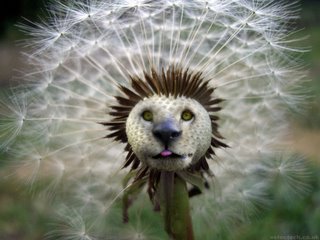
a) I read a posting on a gardening trade bulletin board, someone in the U.S. (forgot which state) was actually requesting dandelion seeds. This was not a common plant where he lived. I happily gathered an envelope full of seeds, and shipped it to him, and I'm sure many others did also. (I couldn't resist posting this dandelion picture from the site http://eclectech.co.uk/. To a child, what flower could be more delightful, and what seed-head could be more inviting, than a dandy-lion?)
b) I had a neighbour who, due to her age and reduced mobility, seldom worked in her garden. Most people would have considered it overrun by undesirable plants or weeds. Yet she often stopped and admired, and praised the plants she was growing there.
2. There is no such thing as total elimination. Weeding is an ongoing process. There is no need to procrastinate with "I've got to get out there some time and weed the whole garden". It can be done whenever there is a little time, or whenever you are just passing by. If it is missed today, it can be pulled tomorrow, although it may require a stronger tug. If it is missed and goes to seed, then its gazillion seedlings can be pulled next season, it just may take a little longer.
3. Weeds are great food for the compost. Many of them send a taproot deep into the soil, and extract important minerals, and others contribute by fixing nitrogen (converting nitrogen in the atmosphere into a form which is useful for plant growth). However, if a weed has been allowed to flower or set seed, it may be better disposed of, than added to your compost (again, think of the gazillion seedlings).
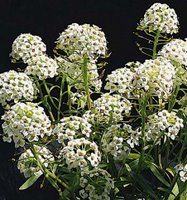
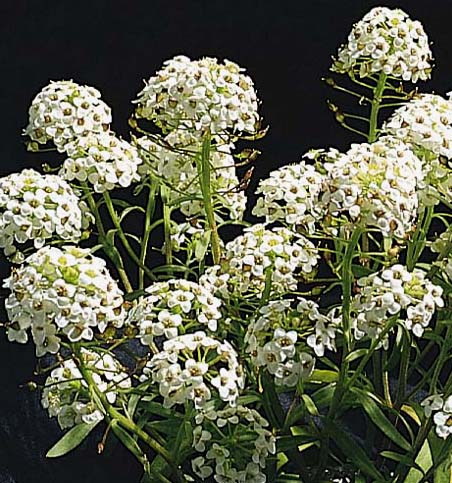
4. Some weeds are ones which we have planted ourselves. I grew alyssum (Lobularia maritima) one year, it was a pretty annual, with its cheery clump of white flowers. I let it go to seed, and the next year, I had it sprouting throughout my garden. For me, it had become a weed. On the other hand, the same thing happened with my lobelia, and I enjoyed the cheery clumps of blue speckled throughout my garden - so far!
5. There are no mistakes with weeding. If the same plant is popping up throughout your garden, you can safely start removing it now. As a gardener, if you don't like something, there is no mistake in composting, relocating, or giving it away. If you're not sure if it's a weed for you or not, let it grow for a while longer, but keep an eye on it, and make a decision by the time it flowers - don't let it self-seed, or you're in for more work next year.
6. Weeding can be very theraputic. Some people enjoy a good game of golf. Others learn to enjoy the simple pleasure of uprooting weeds. I have found that there is no method more pleasurable - or effective - than simple hand pulling. Unless it is very soft soil, I find it useful to carry a small hand shovel / trowel in one hand, to poke below the weed, and then pull it with the other hand. If the weeds are prickly, a good garden glove helps. If not, there is some pleasure in the coolness of the plants, the grittiness of the soil, and the childlike pleasure of getting dirty.
7. Think positive thoughts. Weeds can be admired for their amazing growing abilities. "Wow, look how fast this little guy has grown!" "If only my favourite flower could self-sow like this one, I'd soon have a large patch, and could share with all my friends." Or, you can enjoy the results of your labours. "Now that I've cleared out some space, won't my favourite flowers have even more room to grow!" Don't despair about what is left to be done, enjoy what little progress you've made.
Happy weeding!
Here's a few thoughts which have helped me to enjoy the weeding process.
1. "One person's weed is another person's wildflower". A weed is simply a plant growing where we want a different plant to grow. Weeding is the art of removing healthy, thriving, maintenance-free plants, in favour of a less suited plant, but one which we desire to grow in our garden. A few examples:

a) I read a posting on a gardening trade bulletin board, someone in the U.S. (forgot which state) was actually requesting dandelion seeds. This was not a common plant where he lived. I happily gathered an envelope full of seeds, and shipped it to him, and I'm sure many others did also. (I couldn't resist posting this dandelion picture from the site http://eclectech.co.uk/. To a child, what flower could be more delightful, and what seed-head could be more inviting, than a dandy-lion?)
b) I had a neighbour who, due to her age and reduced mobility, seldom worked in her garden. Most people would have considered it overrun by undesirable plants or weeds. Yet she often stopped and admired, and praised the plants she was growing there.
2. There is no such thing as total elimination. Weeding is an ongoing process. There is no need to procrastinate with "I've got to get out there some time and weed the whole garden". It can be done whenever there is a little time, or whenever you are just passing by. If it is missed today, it can be pulled tomorrow, although it may require a stronger tug. If it is missed and goes to seed, then its gazillion seedlings can be pulled next season, it just may take a little longer.
3. Weeds are great food for the compost. Many of them send a taproot deep into the soil, and extract important minerals, and others contribute by fixing nitrogen (converting nitrogen in the atmosphere into a form which is useful for plant growth). However, if a weed has been allowed to flower or set seed, it may be better disposed of, than added to your compost (again, think of the gazillion seedlings).

4. Some weeds are ones which we have planted ourselves. I grew alyssum (Lobularia maritima) one year, it was a pretty annual, with its cheery clump of white flowers. I let it go to seed, and the next year, I had it sprouting throughout my garden. For me, it had become a weed. On the other hand, the same thing happened with my lobelia, and I enjoyed the cheery clumps of blue speckled throughout my garden - so far!
5. There are no mistakes with weeding. If the same plant is popping up throughout your garden, you can safely start removing it now. As a gardener, if you don't like something, there is no mistake in composting, relocating, or giving it away. If you're not sure if it's a weed for you or not, let it grow for a while longer, but keep an eye on it, and make a decision by the time it flowers - don't let it self-seed, or you're in for more work next year.
6. Weeding can be very theraputic. Some people enjoy a good game of golf. Others learn to enjoy the simple pleasure of uprooting weeds. I have found that there is no method more pleasurable - or effective - than simple hand pulling. Unless it is very soft soil, I find it useful to carry a small hand shovel / trowel in one hand, to poke below the weed, and then pull it with the other hand. If the weeds are prickly, a good garden glove helps. If not, there is some pleasure in the coolness of the plants, the grittiness of the soil, and the childlike pleasure of getting dirty.
7. Think positive thoughts. Weeds can be admired for their amazing growing abilities. "Wow, look how fast this little guy has grown!" "If only my favourite flower could self-sow like this one, I'd soon have a large patch, and could share with all my friends." Or, you can enjoy the results of your labours. "Now that I've cleared out some space, won't my favourite flowers have even more room to grow!" Don't despair about what is left to be done, enjoy what little progress you've made.
Happy weeding!
Thursday, January 19, 2006
A mid-January Jump Start on the Weeds
It is only mid January, but a walk through the garden finds two types of weeds already in flower, in our mild Pacific Northwest climate. While our all-time record-tying 28 consecutive days of rain discouraged me from venturing near the garden, the invasive and unwelcome plants relished the weather along with all my favourites.
The p
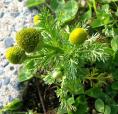
ineapple weed (matricaria matricarioides) - resembling a chamomile
flower - is topped in yellow buds. The bittercress (cardamine hirsuta) is putting out tiny white flowers, and has spread to form patches of the green. After donning garden gloves and kneepads, I am ready for battle. Happily, both yield very easily to the side of my plastic hand shovel (trowel), and soon I have a 5 gallon bucket of food for my compost bin. There is much more which can be done in the garden, but I'm DONE (that's my aching body speaking!) for today.
I take a leisurely walk and visit each of my 9 fruit trees, all but one which show signs of life, tiny buds bulging along the bare twigs. Daylilies are just poking through the surface of the soil, the daffodils and tulips and crocuses (or should I say croci?) are evident. One crocus is even in bud - show off! Pretty satisfying for my first day of gardening in 2006. Lots more rain and possibly snow to expect in the next couple of months, but I'm already anticipating the arrival of Spring.
The p
ineapple weed (matricaria matricarioides) - resembling a chamomile
flower - is topped in yellow buds. The bittercress (cardamine hirsuta) is putting out tiny white flowers, and has spread to form patches of the green. After donning garden gloves and kneepads, I am ready for battle. Happily, both yield very easily to the side of my plastic hand shovel (trowel), and soon I have a 5 gallon bucket of food for my compost bin. There is much more which can be done in the garden, but I'm DONE (that's my aching body speaking!) for today.I take a leisurely walk and visit each of my 9 fruit trees, all but one which show signs of life, tiny buds bulging along the bare twigs. Daylilies are just poking through the surface of the soil, the daffodils and tulips and crocuses (or should I say croci?) are evident. One crocus is even in bud - show off! Pretty satisfying for my first day of gardening in 2006. Lots more rain and possibly snow to expect in the next couple of months, but I'm already anticipating the arrival of Spring.
Subscribe to:
Comments (Atom)