For someone who doesn't even cook dinners more than once or twice per week, I have been doing a LOT of home canning lately. First was the apple juice from the "mystery" apple tree. Then a few batches of mint syrup from the chocolate mint in my garden. Then I did that batch of grape juice from the grapes I needed to pick a bit prematurely last week. Funny how such green grapes can turn into such pink juice:
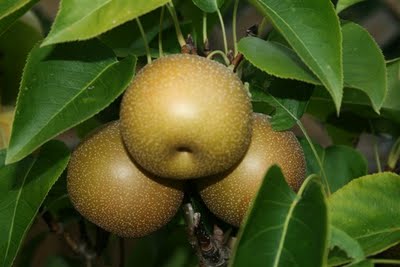
Anyhow, today I picked some of the apples from the espalier tree, mostly to thin the top-most apples, since I have been a bit neglectful recently, and to pick the bottom-most apples which are ripe. I also picked some of the asian pears, to lighten up the branches. This is what I brought in today, and I have much more on the two espalier trees :
Since some of the apple (top-most ones) were too tart, I decided to make juice from some of the apples, and from some of the grapes left over from last week which we didn't end up eating. (I picked some grapes today, and they were much sweeter and easier to eat.) I ended up with a large juice jar, and small individual size juice jar. The apple-grape blend is particularly tasty but ends up pretty drinkable, without adding much water (although quite a bit of sugar).
The bottom-most apple was ripe, but many of them appeared to be bruised, even though I know they didn't fall. That must be some sort of disease, which shows up as brown spots inside the apple. I don't remember it last year. Does anyone recognize this condition?
Anyhow, I still have more fruit coming, in addition to the apples and asian pears. The italian plums produced a very light crop this year, not a heavy one like last year, but when I sampled one today, it was sweet. I would have asked my husband to help climb a ladder to pick them today, but we'll be mostly away the next couple of days, so won't likely have a chance to eat them. Better we wait and pick and eat them fresh.
The fall gold raspberries are absolutely amazing, with large and sweet fruit. I ate quite a few handfuls today, when I was out cleaning up the garden. I put in about 3 hours today, and had my 13 year old join me also, and managed to haul out 8 wheelbarrows of weeds and cuttings!! Mostly blackberry vines and morning glory vines, which were quite out of control this year. The few areas I tackled look MUCH better now.
On a totally unrelated topic, I stumbled upon these adorable bear-hugging-a-nut cookies at this site, and had to share them. Wouldn't that be awesome for a kids' party (except for a nut-free one!) ? :
Showing posts with label espalier. Show all posts
Saturday, August 30, 2014
Sunday, March 04, 2012
Espalier Fruit Trees - You Can Grow That!
I was delighted to discover today the first collaborative posting of the monthly "You Can Grow That" blogging meme series, hosted by C.L. Fornari of Whole Life Gardening, and I knew I had to join. At least this first one. I don't know how often I'll remember it's the 4th day of the month, or have something I can organize, but I instantly knew what I wanted to share : my espalier fruit trees.
My espalier fruit trees are a continual delight to me, as well as to my garden and garden blog visitors. All three are in the horizontal cordon espalier form, and all of them feature 3 different varieties of the same fruit, one on each horizontal level. I have had my apple and asian pear espaliers about 7 years now, in which time their branches have grown from about 1 1/2 feet long to about 8 feet long. My european pear is quite new, added only 4 years ago.
Here is my apple espalier tree, with a closeup of 2 of the varieties of apples:
And here is my espalier asian pear, with a closeup of all 3 varieties of asian pears:
For me, the process of planting and getting them set up was an interative approach, but some of the lessons I've learned are :
1. Leave lots of room for horizontal growth of the branches. I like the look of mine at 8 feet (16 overall), since this is the length of my cedar fence panels. But I think the branches could easily grow to 12 feet or more, with adequate supports.
2. If you plant against a wall or fence, leave room behind for access. Mine are planted about 12" from the fence, and this provides good access to reach behind, to trim branches, etc.
3. You don't need a fence behind. At the UBC Botanical gardens, there are some wonderful examples of espaliers growing beside a path in the food garden, and the espaliers themselves form a fence. But if you have a fence or wall available, it helps to provide reflective heat for fruit production.
4. Provide adequate supports for the branches. Mine are a thick vinyl-coated copper wire ( roughly equivalent to a clothesline), tied to landscaping posts through eyelet hooks. But over time the eyelet hooks are coming loose, so if I re-tied them, I would tie them directly around the posts, and bend a nail over them to keep them from sliding up/down the post.
5. Be diligent in pruning. Over time you will learn to recognize fruit-bearing spurs (which are compact) and the vertical growth which need to be trimmed back aggressively, to allow the tree to put its energy into fruit rather than branch development. I prune them at various times during the year, mostly in spring and summer, when the growth is quite vigorous, and needs to be diverted to the fruit.
6. Be diligent in thinning the fruit. Yes, the fruit is so plentiful, that it needs to be pruned, in order to allow the fruit to develop. Best not to leave more than one or two per fruiting spur, and not closer than 6" apart. This is the task I find the hardest, and I tend to leave too much fruit, creating undue strain on the tree, and ending up with fruits that don't ripen as quickly or fully as they could.
But most of all, I've learned with all of my fruit trees :
7. Start now! Trees are an excellent investment, and grow every year, so if you are thinking about a purchase, don't put it off another year. Prepare your hole, and head to the nursery! The best stock arrives (usually bareroot) in late winter/early spring, so it is that time, or soon will be!
My espalier fruit trees are a continual delight to me, as well as to my garden and garden blog visitors. All three are in the horizontal cordon espalier form, and all of them feature 3 different varieties of the same fruit, one on each horizontal level. I have had my apple and asian pear espaliers about 7 years now, in which time their branches have grown from about 1 1/2 feet long to about 8 feet long. My european pear is quite new, added only 4 years ago.
Here is my apple espalier tree, with a closeup of 2 of the varieties of apples:
And here is my espalier asian pear, with a closeup of all 3 varieties of asian pears:
For me, the process of planting and getting them set up was an interative approach, but some of the lessons I've learned are :
1. Leave lots of room for horizontal growth of the branches. I like the look of mine at 8 feet (16 overall), since this is the length of my cedar fence panels. But I think the branches could easily grow to 12 feet or more, with adequate supports.
2. If you plant against a wall or fence, leave room behind for access. Mine are planted about 12" from the fence, and this provides good access to reach behind, to trim branches, etc.
3. You don't need a fence behind. At the UBC Botanical gardens, there are some wonderful examples of espaliers growing beside a path in the food garden, and the espaliers themselves form a fence. But if you have a fence or wall available, it helps to provide reflective heat for fruit production.
4. Provide adequate supports for the branches. Mine are a thick vinyl-coated copper wire ( roughly equivalent to a clothesline), tied to landscaping posts through eyelet hooks. But over time the eyelet hooks are coming loose, so if I re-tied them, I would tie them directly around the posts, and bend a nail over them to keep them from sliding up/down the post.
5. Be diligent in pruning. Over time you will learn to recognize fruit-bearing spurs (which are compact) and the vertical growth which need to be trimmed back aggressively, to allow the tree to put its energy into fruit rather than branch development. I prune them at various times during the year, mostly in spring and summer, when the growth is quite vigorous, and needs to be diverted to the fruit.
6. Be diligent in thinning the fruit. Yes, the fruit is so plentiful, that it needs to be pruned, in order to allow the fruit to develop. Best not to leave more than one or two per fruiting spur, and not closer than 6" apart. This is the task I find the hardest, and I tend to leave too much fruit, creating undue strain on the tree, and ending up with fruits that don't ripen as quickly or fully as they could.
But most of all, I've learned with all of my fruit trees :
7. Start now! Trees are an excellent investment, and grow every year, so if you are thinking about a purchase, don't put it off another year. Prepare your hole, and head to the nursery! The best stock arrives (usually bareroot) in late winter/early spring, so it is that time, or soon will be!
PS. Come join in the 4th of each month with your own "You Can Grow That" post, at Whole Life Gardening.
Thursday, September 03, 2009
Signs of Fall and Fruit Harvest Sampler
Our family took a short trip to Las Vegas, and during those 4 days, the burning bush (Euonymus alata) started to turn red, a sure sign that Fall is approaching:

Although the crazy apple tree doesn't think so (see full story):

I still don't know what variety of apple my "mystery apple" tree is, but it is crisp, with quite a bit of tartness.

Some of the apples (the ones which got the most sun, I guess) are quite red:

My golden raspberries are back in fruit again:

This is poor photo, but it is curious to me that the late raspberry crop pollinator seems to be this large black wasp, which have been buzzing about the raspberries for the past few weeks:

My grape vines bore grapes for the first time this year, so I can finally find out what type they are. When I was given the cuttings a few years back, I happily took them, but didn't find out at the time. Well, I see now that my 3 vines are 3 different varieties of grapes.
I have a dark one, which only bore 2 bunches of fruit, and looks like it may be a wine/juice variety:

The most prevalent is a green one which also looks like it may be a wine/juice variety, with firm skin:

The third variety is also green, but the fruits look more delicate, like a table/eating grape, and when I sampled some today, they were already quite sweet:

I have room for a 4th vine, and hope to just buy a nice eating variety (or ask my neighbour who has a very sweet green one).
The espalier apple tree has borne 2 types of apples, neither of which is ready yet. If I look back, I'll see what the varieties are, but I'm too lazy at the moment. This is the "top row" apple:

...and the "bottom row" apple (the "middle row" one didn't bear this year) - I love the bright red of this one!:

The espalier asian pear bore a lot of fruit this year, and happily the fruit is very sweet even when small, so I have been doing some late "pruning" (sampling) of the fruit recently. Again, I am too lazy to look up the varieties, but this is the "top row" asian pear:

...and "middle row" asian pear:

...and "bottom row" asian pear:

I also picked another sample of the italian plum, which is not yet ripe, but also very sweet already. And some late strawberries. And a poor Bartlett pear (one of the two this year) which fell too early. The handfuls of blackberries didn't last long enough for the photo of my little harvest from my garden walk today:

It made for a tasty treat for the kids to sample with me:

Fall may be fast approaching, but this is a very delicious time of year in the garden, indeed.

Although the crazy apple tree doesn't think so (see full story):

I still don't know what variety of apple my "mystery apple" tree is, but it is crisp, with quite a bit of tartness.

Some of the apples (the ones which got the most sun, I guess) are quite red:

My golden raspberries are back in fruit again:

This is poor photo, but it is curious to me that the late raspberry crop pollinator seems to be this large black wasp, which have been buzzing about the raspberries for the past few weeks:

My grape vines bore grapes for the first time this year, so I can finally find out what type they are. When I was given the cuttings a few years back, I happily took them, but didn't find out at the time. Well, I see now that my 3 vines are 3 different varieties of grapes.
I have a dark one, which only bore 2 bunches of fruit, and looks like it may be a wine/juice variety:

The most prevalent is a green one which also looks like it may be a wine/juice variety, with firm skin:

The third variety is also green, but the fruits look more delicate, like a table/eating grape, and when I sampled some today, they were already quite sweet:

I have room for a 4th vine, and hope to just buy a nice eating variety (or ask my neighbour who has a very sweet green one).
The espalier apple tree has borne 2 types of apples, neither of which is ready yet. If I look back, I'll see what the varieties are, but I'm too lazy at the moment. This is the "top row" apple:

...and the "bottom row" apple (the "middle row" one didn't bear this year) - I love the bright red of this one!:

The espalier asian pear bore a lot of fruit this year, and happily the fruit is very sweet even when small, so I have been doing some late "pruning" (sampling) of the fruit recently. Again, I am too lazy to look up the varieties, but this is the "top row" asian pear:

...and "middle row" asian pear:

...and "bottom row" asian pear:

I also picked another sample of the italian plum, which is not yet ripe, but also very sweet already. And some late strawberries. And a poor Bartlett pear (one of the two this year) which fell too early. The handfuls of blackberries didn't last long enough for the photo of my little harvest from my garden walk today:

It made for a tasty treat for the kids to sample with me:

Fall may be fast approaching, but this is a very delicious time of year in the garden, indeed.
Monday, August 24, 2009
What's Up With That Apple Tree?
My little apple tree which bore only 1 fruit in 2006, and has slowly been adding a fruit or two each year, is bearing a number of apples this year:

In fact, a few apples have already fallen, and I've enjoyed sampling them. But a few days ago, I noticed.... blossoms?

In fact there are a number of blossoms, right alongside the fruit which is nearly ripe:


This next photo shows apple blossoms (at bottom, a bit washed out by the camera's flash) with near-ripe apples, and a number of green raspberries overhead:

Yes, the golden raspberries are putting out another crop:

But that's nothing new, they seem to put out a summer & a fall crop each year, yielding a nice sweet surprise as late as October and November.
Anyhow, this is not about the raspberries.... or is it? I now remember that about a month or so ago, I decided to cut back some of the apple branches, since they were colliding with the raspberry patch along the fence, making it hard to walk through that area. Also, I figured it would be better to have shorter stronger branches rather than longer weaker ones. But looking closer tonight, I realize that it is each of the branches which I cut back, which put out the blossoms. So maybe some magical combination of a dip in temperature followed by more warm weather, and the cutting back of the branches, seemed to trigger the blossoms.
I hope this will not affect the tree's ability to respond to the REAL spring when it comes. I'll see if any fruit sets from these blossoms. I think it would be wise to remove any fruit before the winter.
I suppose this illustrates why my espalier apples are always very efficient at producing fruit (and each year I need to prune back the fruits very aggressively). Since the tree's upward growth is continually impaired, more energy is directed to bearing fruit:

The same with my espalier asian pear, which I didn't prune aggressively enough this year (and I also need to tie up the branch tips):

While I'm shamelessly showing off my fruit, here is my italian plum tree this year, which bore exactly 5 fruit last year. The fruits are very sweet, and freestone.


I don't know what causes the scars on most of the plums, could that be a disease? Does anyone recognize it?
The grapes have finally established on the side of the shed, and this is the first year we've had fruit. So I'll be able to find out what types of grapes I've been trying to grow these past few years (since I didn't pay enough attention at the time - they were a gift of cuttings):


In fact, a few apples have already fallen, and I've enjoyed sampling them. But a few days ago, I noticed.... blossoms?

In fact there are a number of blossoms, right alongside the fruit which is nearly ripe:


This next photo shows apple blossoms (at bottom, a bit washed out by the camera's flash) with near-ripe apples, and a number of green raspberries overhead:

Yes, the golden raspberries are putting out another crop:

But that's nothing new, they seem to put out a summer & a fall crop each year, yielding a nice sweet surprise as late as October and November.
Anyhow, this is not about the raspberries.... or is it? I now remember that about a month or so ago, I decided to cut back some of the apple branches, since they were colliding with the raspberry patch along the fence, making it hard to walk through that area. Also, I figured it would be better to have shorter stronger branches rather than longer weaker ones. But looking closer tonight, I realize that it is each of the branches which I cut back, which put out the blossoms. So maybe some magical combination of a dip in temperature followed by more warm weather, and the cutting back of the branches, seemed to trigger the blossoms.
I hope this will not affect the tree's ability to respond to the REAL spring when it comes. I'll see if any fruit sets from these blossoms. I think it would be wise to remove any fruit before the winter.
I suppose this illustrates why my espalier apples are always very efficient at producing fruit (and each year I need to prune back the fruits very aggressively). Since the tree's upward growth is continually impaired, more energy is directed to bearing fruit:

The same with my espalier asian pear, which I didn't prune aggressively enough this year (and I also need to tie up the branch tips):

While I'm shamelessly showing off my fruit, here is my italian plum tree this year, which bore exactly 5 fruit last year. The fruits are very sweet, and freestone.


I don't know what causes the scars on most of the plums, could that be a disease? Does anyone recognize it?
The grapes have finally established on the side of the shed, and this is the first year we've had fruit. So I'll be able to find out what types of grapes I've been trying to grow these past few years (since I didn't pay enough attention at the time - they were a gift of cuttings):

Thursday, May 28, 2009
Garden Glimpses : Late May 2009
One of the great things about gardening is that every day, there is something new to discover. Lately I have been too busy during the week, so doing major gardening (mostly weeding) sessions on Saturdays. But I try to get outside every couple of days to at least walk about and see what is new. This evening did not disappoint.
A number of plants have seeded themselves among our stone-faced steps and gravel pathway which connects the lower yard to the upper yard. I pull the ones which look out of place or are too weedy, but have left some where they fit in nicely. This one found a very cozy and natural-looking spot:

I plan to relocate these weedy daisies when they are finished flowering, but even these "common" flowers add some charm to the pathway:

This tricolour honeysuckle is filling in nicely against our cedar fence, and it loaded with blooms this year:

I discovered that the rhodo which is tucked in the corner against the shed, now almost hidden behind the Italian Plum tree, is just coming into bloom:

I found the first bloom of the year on my white iris, a treasured gift from my friend Irene:

The first flower has appeared on my tomato plants. I have 2 "sweet 100" and 2 "sweet 1000" tomatoes this year. So if all goes well, I guess I can expect approx 2,200 fruits:

My climbing hydrangea, which started as a tiny shoot less than 5 years ago, and now completely covers its concrete retaining wall, has finally shown 2 flower heads (umbels, I guess?) this year. Not that I was anxious about flowers, since the twisty vines in winter and the lush foliage in summer is more than enough to earn its spot in the garden:

I don't have the name of this orange flower handy, but its yellow relative grows as a native weed in this area, some of it just beyond my fence on the ravine side. I sure do like this cheery orange version, though:

The smoke tree is getting ready to smoke:

There were lots of fruits to discover also, such as these Bartlett pears. I am amused by how they grow "upside down" until they get heavy enough for the fruit to drop to the orientation I'm used to seeing pears in:

The espalier trees always perform well with fruiting, mainly due to all other growth being so restricted, the tree has nowhere else to expend its energies other than into producing fruit. This is one of our espaliered apples:

...and espaliered asian pears:

I try to thin the espalier fruits to only 1 per clump, and even then that may be too dense, I should probably thin more aggressively, and try for one fruit every 4 inches.
I started grapes against the shed a couple of years ago, and they are really filling in nicely this year:

And for the first time ever, I see lots of tiny grapes forming:

The Italian plum tree, which bore 5 fruits last year, seems to have dozens of tiny fruits, hiding among the leaves (and hard to photograph well):

But the biggest and most exciting surprise tonight, which prompted me to call my husband and kids out to see for themselves, was our peach tree. Do you remember how we just got the peach tree last year, and it played dead for a long while after it was planted? Then this year, it showed that single flower? Well, that single flower has produced a tiny, fuzzy peach! It is so small, you still need to use your imagination on this one, but it is for sure a little peach!!:
A number of plants have seeded themselves among our stone-faced steps and gravel pathway which connects the lower yard to the upper yard. I pull the ones which look out of place or are too weedy, but have left some where they fit in nicely. This one found a very cozy and natural-looking spot:

I plan to relocate these weedy daisies when they are finished flowering, but even these "common" flowers add some charm to the pathway:

This tricolour honeysuckle is filling in nicely against our cedar fence, and it loaded with blooms this year:

I discovered that the rhodo which is tucked in the corner against the shed, now almost hidden behind the Italian Plum tree, is just coming into bloom:

I found the first bloom of the year on my white iris, a treasured gift from my friend Irene:

The first flower has appeared on my tomato plants. I have 2 "sweet 100" and 2 "sweet 1000" tomatoes this year. So if all goes well, I guess I can expect approx 2,200 fruits:

My climbing hydrangea, which started as a tiny shoot less than 5 years ago, and now completely covers its concrete retaining wall, has finally shown 2 flower heads (umbels, I guess?) this year. Not that I was anxious about flowers, since the twisty vines in winter and the lush foliage in summer is more than enough to earn its spot in the garden:

I don't have the name of this orange flower handy, but its yellow relative grows as a native weed in this area, some of it just beyond my fence on the ravine side. I sure do like this cheery orange version, though:

The smoke tree is getting ready to smoke:

There were lots of fruits to discover also, such as these Bartlett pears. I am amused by how they grow "upside down" until they get heavy enough for the fruit to drop to the orientation I'm used to seeing pears in:

The espalier trees always perform well with fruiting, mainly due to all other growth being so restricted, the tree has nowhere else to expend its energies other than into producing fruit. This is one of our espaliered apples:

...and espaliered asian pears:

I try to thin the espalier fruits to only 1 per clump, and even then that may be too dense, I should probably thin more aggressively, and try for one fruit every 4 inches.
I started grapes against the shed a couple of years ago, and they are really filling in nicely this year:

And for the first time ever, I see lots of tiny grapes forming:

The Italian plum tree, which bore 5 fruits last year, seems to have dozens of tiny fruits, hiding among the leaves (and hard to photograph well):

But the biggest and most exciting surprise tonight, which prompted me to call my husband and kids out to see for themselves, was our peach tree. Do you remember how we just got the peach tree last year, and it played dead for a long while after it was planted? Then this year, it showed that single flower? Well, that single flower has produced a tiny, fuzzy peach! It is so small, you still need to use your imagination on this one, but it is for sure a little peach!!:
Labels:
espalier,
flower photos,
fruit trees,
garden glimpses
Subscribe to:
Comments (Atom)