Okay I'm a freak for bugs, but I am really enjoying my spiny leaf insect which hatched 2 weeks ago. When I open the door to her cage, she seems to sense it, and finds her way out. She is so interesting to handle, since she runs very quickly, her tail tightly curled, and then when she calms down, she slows down, and lets her tail unroll. The stick bugs move when provoked, but rarely do much walking, and when they do, it is much slower. Here are a few photos of my spiny leaf girl (they will all be girls) from today (click any photo for a slightly larger image):
The red colour in her head is gone, but isn't she still freaky looking? I am really fascinated by her.
We had a second one hatch a few days later, but it had a gimpy front leg, and has not done well. I don't think it will last until tomorrow. Earlier today I found it lying on its face on the bottom of the cage, its body quite shrunken flat. So I pulled it out, and gave it some water in my hand. It seemed to drink, and revived and filled out a bit. I also finally removed the leg, since it was stumbling on it, and having difficulty moving forward at all. Later today I found it looking almost dead again, and gave it some sugar-water in my hand. Again, it seemed to drink, and its body filled out a bit, but it didn't revive very much. Instead of its tail curling up, it hangs down onto the ground. Poor little thing. I hope more eggs will hatch soon.
Friday, April 29, 2011
Wednesday, April 27, 2011
Fruit Tree Blossoms
The fruit tree are one month behind compared to last year, but at last they are bursting into blossoms. Here is the asian pear espalier:
The european pear espalier, being younger, is off to a good start (although it looks overwhelmed by the massive honesuckle vine behind it, which I keep trimmed back from the pear tree):
The following shows my Frost peach tree (left) and Rainier cherry, with closeups of the blossoms.
In the mosaic below...
Top: Ribes odoratum (Missouri currant), which is loaded with more fragrant blooms every year, but disappointingly bears almost no currants. I am sure I have seen pollinators in previous years (although this year will be pretty challenging, with every second day raining - today it rained very hard).
Bottom left : Lapin (dark) cherry blossoms, with yellow ribes blossoms behind.
Bottom right : One of my rhubarb plants looks like it will flower this year. I am reading that this should be discouraged, by removing the flower. So I'll keep my eye on it. Perhaps capture a few more photos, before I take such drastic action.
My new garden path is looking pretty nice, with the peonies and hostas just starting to shoot up on both sides.
The weeping cherry (Prunus "Snofozam" or "Snow fountains") in the center is barely visible. A couple of weeks ago, it was the only tree in full bloom:
The Alchemilla mollis (Lady's mantle) is not a showy plant, but I love the way it holds beads of rain:
Finally, since I tackle various parts of my garden at random, so often forgot to capture "before" and "after" photos, these are kinda "mid" photos - I've done some cleanup (as evidenced by soil being visible, which it would not have been in the "before" scene), but still have much to do, so it is not really "after". I am clearing out sections of rampant bluebells, removing (and finding good homes for) daylilies which have spread too far, and removing chunks of fall asters which are too widespread, leaving instead tidier "clumps" of them. It feels good to finally make some progress on this section of garden:
The european pear espalier, being younger, is off to a good start (although it looks overwhelmed by the massive honesuckle vine behind it, which I keep trimmed back from the pear tree):
The following shows my Frost peach tree (left) and Rainier cherry, with closeups of the blossoms.
In the mosaic below...
Top: Ribes odoratum (Missouri currant), which is loaded with more fragrant blooms every year, but disappointingly bears almost no currants. I am sure I have seen pollinators in previous years (although this year will be pretty challenging, with every second day raining - today it rained very hard).
Bottom left : Lapin (dark) cherry blossoms, with yellow ribes blossoms behind.
Bottom right : One of my rhubarb plants looks like it will flower this year. I am reading that this should be discouraged, by removing the flower. So I'll keep my eye on it. Perhaps capture a few more photos, before I take such drastic action.
My new garden path is looking pretty nice, with the peonies and hostas just starting to shoot up on both sides.
The weeping cherry (Prunus "Snofozam" or "Snow fountains") in the center is barely visible. A couple of weeks ago, it was the only tree in full bloom:
The Alchemilla mollis (Lady's mantle) is not a showy plant, but I love the way it holds beads of rain:
Finally, since I tackle various parts of my garden at random, so often forgot to capture "before" and "after" photos, these are kinda "mid" photos - I've done some cleanup (as evidenced by soil being visible, which it would not have been in the "before" scene), but still have much to do, so it is not really "after". I am clearing out sections of rampant bluebells, removing (and finding good homes for) daylilies which have spread too far, and removing chunks of fall asters which are too widespread, leaving instead tidier "clumps" of them. It feels good to finally make some progress on this section of garden:
Saturday, April 23, 2011
Weeds in the Garden of Eden : Part 2 : Types of Gardeners
![]() |
| Garden of Eden Source unknown - used without explicit permission |
There are two types of gardeners:
Homo contentinhumus - The true gardener, who is truly happy being up to the elbows in soil and plants, and often doesn't even care that he or she will later suffer from allergies. This is the gardener who has a garden (noun) so that he or she can "garden" (verb) there - pulling weeds, moving plants, amending soil... He or she may set up a bench in the garden, since it sets off the colours and textures of the plants so nicely, but has no time to actually sit in it. In utter but euphoric exhaustion, he or she is often found instead sprawled on the porch of the shed, or kneeling for a while in the soil, or leaning against a fence while catching his or her breath and picking the leaves out of her hair.
Homo Hortaverbosa - The pretend gardener, who spends a couple of hours twice a year, but talks about how much he or she worked in the garden for proportionately too long. This is the type of person who tries to sound interested in plants, but elects only the "low maintenance" ones chosen and installed by his or her landscaper. He or she may walk about the yard occasionally to inspect the "garden" (landscaping), but quickly retreats to the comforts of the deck, and home. He or she thinks of gardening (verb) as a chore, done only to have a nice "garden" (noun).
I'd venture that anyone who has made it this far into my blog post, is not only the true gardener, but is probably resting at the computer after exhausting yourself in the garden earlier today. Besides, it's already dark, so not much more can be done in the garden tonight.
By definition, the Garden of Eden was a place of perfection, where all creatures existed in peace and love and fulfillment. So I would venture that when God commanded Adam and Eve to be "fruitful and multiply" and to garden there, that the gardening and the playing around (nudge, nudge, wink, wink) in the garden was enjoyable to them. (Okay, the scriptures don't explicitly refer to gardening (verb), but I'm sure that they were not only to eat the fruit there, but they must have also tended to the garden, since later the curse was that the gardening would be a "toil", and they would need to deal with "thorns and thistles".)
So if the gardening was a source of fulfillment, then Adam and Eve were true gardeners, who enjoyed this activity. So by extension, true gardeners also enjoy moving plants about, and "weeding" out ones in favour of others. Even if Adam may have been content with harvesting fruit, and leaving things where things were planted, Eve must have had some ideas of how the planting arrangement could be improved. After all, it's not only a woman's prerogative to move things about, but it is a God-given gift to imagine and create and effect change. (Certainly not a result of the fall into sin. I'd venture that the effects of sin was the subsequent reluctance of the man to help her anymore with making the changes she still imagined, and leaving her to "toil" on her own - oops, getting too personal here!)
Since all plants bear seeds or runners or other means of propagating successfully, they all need tending to keep them organized, and keep any garden area from becoming totally overgrown. Especially for fruit-bearing plants, they need tending and pruning and "weeding" around them to keep them bearing successfully.
Okay, where am I going with all this? Since the definition of a "weed" as set out in Part 1 is a plant growing where we want it not to grow, and the first couple - who were true gardeners - enjoyed moving things about and changing planting arrangements, and cleaning up the garden to allow for successful fruit bearing, then it follows logically that they must have needed to remove plants from the garden. Therefore, there were weeds in the Garden of Eden!
This thought makes me feel pretty good, and I'm up to my elbows in dirt again today, removing weeds.
Thursday, April 21, 2011
Weeds in the Garden of Eden : Part 1 : What is a Weed?
Occasionally while I am up to my elbows in dirt and weeds, I muse about whether there were weeds in the Garden of Eden. Today I came to the conclusion that there were indeed weeds in the Garden of Eden, and can logically prove it.
First of all, what is a weed? By definition, a weed is simply a plant we don't want growing where it is successfully growing. Newbie gardeners may be surprised by that. One of the common questions of a newbie gardener is "Is this a weed?" It's a weed if you consider it a weed. Plants by their very nature are not "weeds" or favoured garden plants. There are simply plants which are too successful and too prevalent for our gardening conditions, that they are considered "weeds". Case in point : When I used to participate in seed trading forums, I remember someone posting that he was looking for dandelion seeds. In his gardening zone/conditions, the dandelion was a difficult plant to grow, and thus desirable to attempt in his garden. In my gardening conditions, my lawn would be all moss and dandelions if I would let nature decide. If it weren't for its rampant success, I'd be planting dandelions in my garden also, since it displays the prettiest and most vibrant yellow of all the plants I can think of.
Many of our "weeds" may even be plants we've introduced to our gardens intentionally. In my early days of gardening, I brought home many treasured plants from plant trades, which would later, after taking over much of my garden, become weeds which I now remove on sight. Most notably for me is the Carex pendula (Weeping sedge) which I brought home from a plant trade, and planted it on our moist hillside. It was pretty, and even seeded itself about the garden. The first couple of years, I was bringing the strong, green seedlings to plant trades myself, and finding good homes for them. It wasn't until it proceeded to seed itself by the millions, at which point it had grown to such a large and strong clump that I couldn't dig it out myself, that I became alarmed and called on my neighbour to help me remove it. I am still pulling Carex seedlings by the hundreds, years later. (My neighbour ended up planting the clumps, but I don't believe they were successful, or just marginally so, so we are still on talking terms.)
At our last home, our neighbour (on the other side of the duplex) was an elderly lady who enjoyed occasionally inspecting her "garden" which was composed of a wild overgrowth of plants which many experienced gardeners would consider "weeds". To her, they were her pride and joy, growing successfully with almost little effort on her part. Funny, although I was amused by this, I also brought some of her weedy plants with me when I left : Hyacinthoides hispanica (Spanish bluebells), which formed the basis of my blue shade garden, until I filled it in with other blue shade plants, and Lysimachia (Yellow loosestrife), which formed a colourful clump (see photos) in my wild garden at the far back of my yard for some 5 years, until only last year, when I cleaned it up as part of my raspberry garden renovation.
So really, a "weed" or a treasured plant is only in the eye of the beholder. A "weed" is simply a plant growing successfully where we don't want it to grow.
First of all, what is a weed? By definition, a weed is simply a plant we don't want growing where it is successfully growing. Newbie gardeners may be surprised by that. One of the common questions of a newbie gardener is "Is this a weed?" It's a weed if you consider it a weed. Plants by their very nature are not "weeds" or favoured garden plants. There are simply plants which are too successful and too prevalent for our gardening conditions, that they are considered "weeds". Case in point : When I used to participate in seed trading forums, I remember someone posting that he was looking for dandelion seeds. In his gardening zone/conditions, the dandelion was a difficult plant to grow, and thus desirable to attempt in his garden. In my gardening conditions, my lawn would be all moss and dandelions if I would let nature decide. If it weren't for its rampant success, I'd be planting dandelions in my garden also, since it displays the prettiest and most vibrant yellow of all the plants I can think of.
Many of our "weeds" may even be plants we've introduced to our gardens intentionally. In my early days of gardening, I brought home many treasured plants from plant trades, which would later, after taking over much of my garden, become weeds which I now remove on sight. Most notably for me is the Carex pendula (Weeping sedge) which I brought home from a plant trade, and planted it on our moist hillside. It was pretty, and even seeded itself about the garden. The first couple of years, I was bringing the strong, green seedlings to plant trades myself, and finding good homes for them. It wasn't until it proceeded to seed itself by the millions, at which point it had grown to such a large and strong clump that I couldn't dig it out myself, that I became alarmed and called on my neighbour to help me remove it. I am still pulling Carex seedlings by the hundreds, years later. (My neighbour ended up planting the clumps, but I don't believe they were successful, or just marginally so, so we are still on talking terms.)
At our last home, our neighbour (on the other side of the duplex) was an elderly lady who enjoyed occasionally inspecting her "garden" which was composed of a wild overgrowth of plants which many experienced gardeners would consider "weeds". To her, they were her pride and joy, growing successfully with almost little effort on her part. Funny, although I was amused by this, I also brought some of her weedy plants with me when I left : Hyacinthoides hispanica (Spanish bluebells), which formed the basis of my blue shade garden, until I filled it in with other blue shade plants, and Lysimachia (Yellow loosestrife), which formed a colourful clump (see photos) in my wild garden at the far back of my yard for some 5 years, until only last year, when I cleaned it up as part of my raspberry garden renovation. Monday, April 18, 2011
Mosaic Monday : Fairy House
I received encouraging comments on the recent photo of my little fairy house, which has survived 3 years now in the garden, with incredible durability, since I built and installed it there in May 2008. So I have assembled a mosaic of photos over the years (click the mosaic for a slightly larger view).
I wish I could have found the photo from three winters ago, when it was completely covered in a mound of snow. See this post, which shows it just prior to being buried.
Pop over to Little Red House for more of this week's Monday Mosaics.
I wish I could have found the photo from three winters ago, when it was completely covered in a mound of snow. See this post, which shows it just prior to being buried.
Pop over to Little Red House for more of this week's Monday Mosaics.
Sunday, April 17, 2011
Plant Sale Season
As a gardener, this is one of my favourite times of the year. There is much to clean up in the garden, there are blossoms and signs of new growth everywhere, and my favourite plant sales to attend. Today was one of them, the South Burnaby Garden Club's sale held in the Buy Low parking lot in South Burnaby.
Since it started at 9am, and church starts at 10am, I convinced the family to get up early to join me (actually, I gave them the option to let me go on my own, and meet up at the church, but they chose to join me). My mom is actually a member of the club, so we picked her up on the way there.
Sadly for me, the focus this year was on edibles, but I pretty much have all the herbs that I need, and I really don't do vegetable gardening. Although I made the exception for a very gorgeous red-veined plant which is slightly sour and can be used in salads. I am too lazy to go outside to look at the tag for the name.
My delight this year was to pick up a small pot of Mousetail plant (Arisarum proboscideum), which I have since read is a relative of the Jack-in-the-Pulpit. It has lovely green spade-shaped leaves, and funny little flower spikes which look like a mouse's tail. I separated the tiny plants, and put most of them in the fairy garden, and a couple into my native/shade garden. (Click on any image for a slightly larger view.)
I also picked up a few more columbine (they weren't labelled for colour, so it will be a surprise), some hellebore seedlings which will apparently be black/dark flowers (wow, can't wait!), a Japanese iris (again not labelled for colour, but I loved the narrow strong leaves), some dark bearded iris, and a few more plants which caught my interest. Prices at this event are always good, so I came away feeling like I got some bargains, and also supported a local club, so it went to a good cause.
The "big" plant sale for me will be the Van Dusen Gardens sale (Vancouver, BC), which is May 1, 10am - 4pm. Sadly, it will be early afternoon before I can get there, after church and lunch with the family, but unless the weather is miserable, it is worth it just to enjoy strolling the gardens for free, taking a few photos, and if I pick up some neat plants (as I always do), that is a bonus.
My other favourite plant sale, the BRAGS (Burnaby Rhododendrum and Garden Society) fund raiser, will be held May 1 at Shadbolt Center, in conjunction with the Burnaby Rhododendrum Festival (the rhodo is the official flower of Burnaby). So not only will it be more crowded, and unlikely to get parking nearby, but it is the same day as the Van Dusen sale. So this will not be an option for me this year. Too bad. Usually I pick up some plants on my way to church, then a few more at 1/2 price (as they are closing up) on the way home from church.
The weather has been interesting. Alternating between beautiful sunny days and rain with snow/hail mixed in. Good thing Friday & today were the sunny days, and both days I got out in the garden for a few hours. There is much to do, and if I thought of it as a job, trying to remove weeds and straighten out my gardens, I would be overwhelmed. But I take it as therapy, and do what I can. By the time I come back inside, I am so exhausted I can hardly walk, but at peace with the world, at least for a little while.
Friday I did a significant clean up of the raspberry patch. Today, I cleaned in various places, but the most rewarding was to recover the path in the fairy garden, which I built out of smooth stones and shiny marbles, but has been grown over for some time now. Here it is after today's clean up (and note the Mousetail plants to the right of the house):
I marvel at that little fairy house, built from cuttings of my butterfly bush, and roof from my blue oat grass. It has survived 3 winters now, and still looks amazingly fresh. I didn't know I was so good at fairy house construction. If I didn't know how much work it was, I would be tempted to build some more.
Yesterday, between showers, our family took a walk around Deer Lake, but instead of walking the full perimeter, I convinced them to detour through the Century Gardens around Shadbolt Center and the Burnaby Art Gallery. The gardens were pretty. I want to end with some photos I took yesterday.
I love this grotesquely contorted tree. Somewhere I have jotted down the name of it, from the "Burnaby's Great Tree Hunt" book I borrowed from the library, but I don't remember where I put it now. Hmmm.
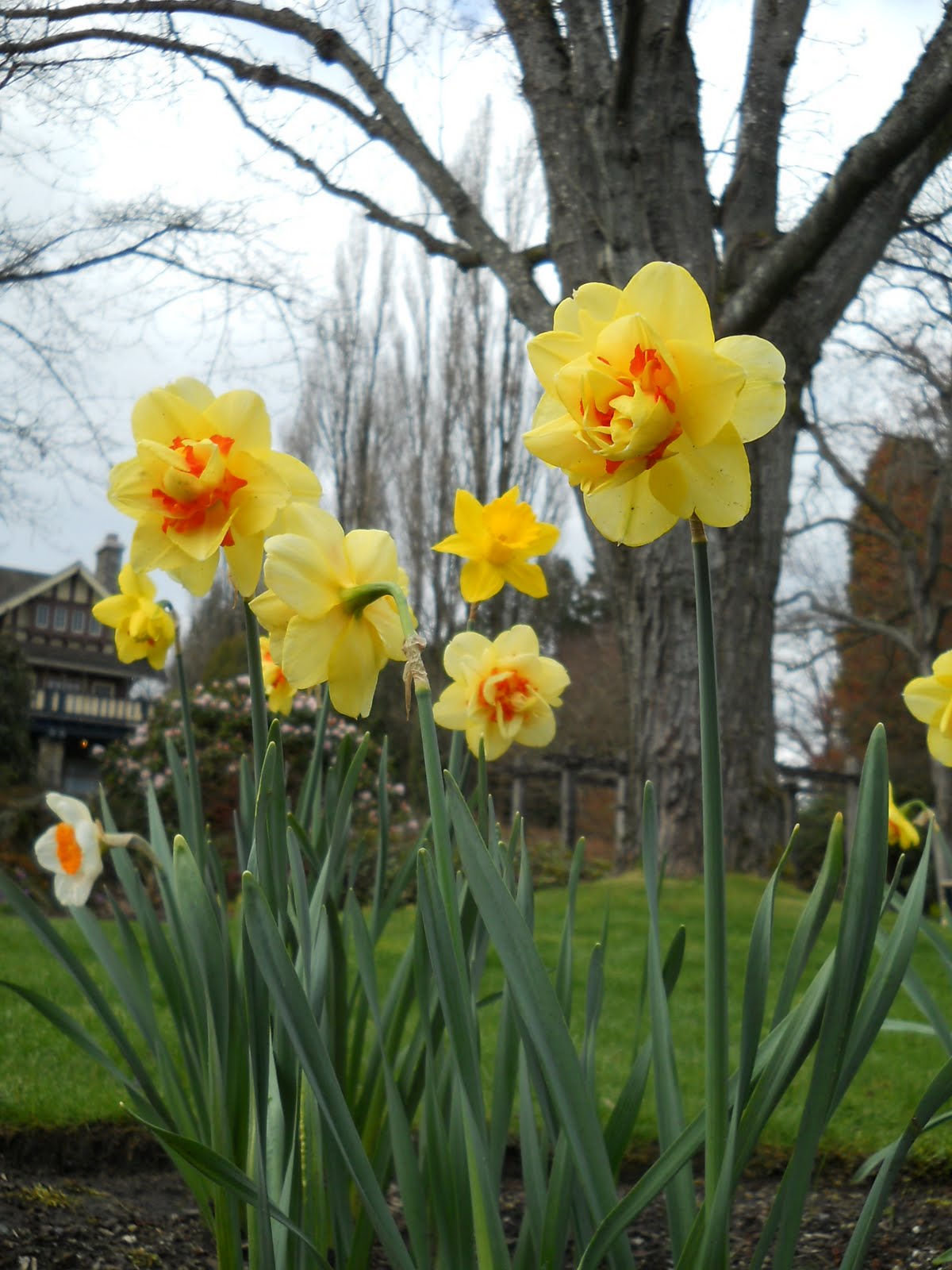
This was a pretty narcissus, with the double/triple center:
The hellebores were in bloom, and there were very large sized clumps of them. Quite impressive.
I didn't know that trilliums also form a beautiful clump. I was very happy to see that I have one small white trillium blooming in my garden now, I bought it at the South Burnaby Garden Club sale last year.
My daughter April took this beautiful photo of emerging fern fronds. They look like a sad couple about to embrace.
I believe this purple beauty is a Primula denticulata:
Since it started at 9am, and church starts at 10am, I convinced the family to get up early to join me (actually, I gave them the option to let me go on my own, and meet up at the church, but they chose to join me). My mom is actually a member of the club, so we picked her up on the way there.
Sadly for me, the focus this year was on edibles, but I pretty much have all the herbs that I need, and I really don't do vegetable gardening. Although I made the exception for a very gorgeous red-veined plant which is slightly sour and can be used in salads. I am too lazy to go outside to look at the tag for the name.
My delight this year was to pick up a small pot of Mousetail plant (Arisarum proboscideum), which I have since read is a relative of the Jack-in-the-Pulpit. It has lovely green spade-shaped leaves, and funny little flower spikes which look like a mouse's tail. I separated the tiny plants, and put most of them in the fairy garden, and a couple into my native/shade garden. (Click on any image for a slightly larger view.)
I also picked up a few more columbine (they weren't labelled for colour, so it will be a surprise), some hellebore seedlings which will apparently be black/dark flowers (wow, can't wait!), a Japanese iris (again not labelled for colour, but I loved the narrow strong leaves), some dark bearded iris, and a few more plants which caught my interest. Prices at this event are always good, so I came away feeling like I got some bargains, and also supported a local club, so it went to a good cause.
The "big" plant sale for me will be the Van Dusen Gardens sale (Vancouver, BC), which is May 1, 10am - 4pm. Sadly, it will be early afternoon before I can get there, after church and lunch with the family, but unless the weather is miserable, it is worth it just to enjoy strolling the gardens for free, taking a few photos, and if I pick up some neat plants (as I always do), that is a bonus.
My other favourite plant sale, the BRAGS (Burnaby Rhododendrum and Garden Society) fund raiser, will be held May 1 at Shadbolt Center, in conjunction with the Burnaby Rhododendrum Festival (the rhodo is the official flower of Burnaby). So not only will it be more crowded, and unlikely to get parking nearby, but it is the same day as the Van Dusen sale. So this will not be an option for me this year. Too bad. Usually I pick up some plants on my way to church, then a few more at 1/2 price (as they are closing up) on the way home from church.
The weather has been interesting. Alternating between beautiful sunny days and rain with snow/hail mixed in. Good thing Friday & today were the sunny days, and both days I got out in the garden for a few hours. There is much to do, and if I thought of it as a job, trying to remove weeds and straighten out my gardens, I would be overwhelmed. But I take it as therapy, and do what I can. By the time I come back inside, I am so exhausted I can hardly walk, but at peace with the world, at least for a little while.
Friday I did a significant clean up of the raspberry patch. Today, I cleaned in various places, but the most rewarding was to recover the path in the fairy garden, which I built out of smooth stones and shiny marbles, but has been grown over for some time now. Here it is after today's clean up (and note the Mousetail plants to the right of the house):
I marvel at that little fairy house, built from cuttings of my butterfly bush, and roof from my blue oat grass. It has survived 3 winters now, and still looks amazingly fresh. I didn't know I was so good at fairy house construction. If I didn't know how much work it was, I would be tempted to build some more.
Yesterday, between showers, our family took a walk around Deer Lake, but instead of walking the full perimeter, I convinced them to detour through the Century Gardens around Shadbolt Center and the Burnaby Art Gallery. The gardens were pretty. I want to end with some photos I took yesterday.
I love this grotesquely contorted tree. Somewhere I have jotted down the name of it, from the "Burnaby's Great Tree Hunt" book I borrowed from the library, but I don't remember where I put it now. Hmmm.
This was a pretty narcissus, with the double/triple center:
The hellebores were in bloom, and there were very large sized clumps of them. Quite impressive.
I didn't know that trilliums also form a beautiful clump. I was very happy to see that I have one small white trillium blooming in my garden now, I bought it at the South Burnaby Garden Club sale last year.
My daughter April took this beautiful photo of emerging fern fronds. They look like a sad couple about to embrace.
I believe this purple beauty is a Primula denticulata:
Saturday, April 16, 2011
New "Baby" in the House - Leaf Insect
I admit that I am a bit strange, but I was very excited yesterday to discover a new "baby" in the house - my first spiny leaf insect (Extatosoma tiaratum). I received about a dozen eggs a couple of months ago, and have been waiting patiently ever since. They have been well worth the wait!
The baby leaf bug is similar in size to my baby stick bugs, but a stockier build, very dark with a red head. When I tried to pick her up, instead of moving slowly like the stick bugs, this little gal starting marching quickly, almost running on my hand, and did not hesitate to jump when she reached the edge of my hand! If I didn't know she was a gentle vegetarian bug, I'd be scared to touch her. She looks downright fierce! When disturbed, she rolls his little dark tail into a tight ball, looking like a biting ant.
We had a hard time taking photos with her moving so quickly, so this is all I can share so far:
17April2011 - Here is another photo, a closeup showing the curled tail and pointy head:
The baby leaf bug is similar in size to my baby stick bugs, but a stockier build, very dark with a red head. When I tried to pick her up, instead of moving slowly like the stick bugs, this little gal starting marching quickly, almost running on my hand, and did not hesitate to jump when she reached the edge of my hand! If I didn't know she was a gentle vegetarian bug, I'd be scared to touch her. She looks downright fierce! When disturbed, she rolls his little dark tail into a tight ball, looking like a biting ant.
We had a hard time taking photos with her moving so quickly, so this is all I can share so far:
For comparison, here is a newly hatched baby stick insect:
Wednesday, March 30, 2011
Southwest / Canyonlands Photos
We just returned Sunday from a dream tour of the Southwest US, with hundreds of wonderful photos and memories, and plans to return again soon. My only regret is that we took only the one week the kids had for Spring Break, so it was aggressive to cover the 1500 miles and numerous National Parks and Monuments which we knew we couldn't miss. Most of these were ones my husband and I had visited 13 years ago, when I was first pregnant, and we had our final fling - a 3 week driving trip from Vancouver BC, camping in our tent (many places without running water) and staying in modest motels. This time, with the kids, we stayed in Holiday Inns and Best Westerns, which was good, since it was still quite chilly and even snowy in some of the locations.
This is a collage of many of the beautiful locations we visited:
We flew into Las Vegas, staying two nights at the gorgeous Venetian, catching their haunting and powerful Phantom of the Opera show - I highly recommend it. I haven't downloaded the photos from the small camera yet, but we also visited the Siegfried and Roy Secret Garden (with tigers, lions, panthers, etc) and Dolphin Habitat, and spent a lot of time gazing at the amazing painted ceilings at The Venetian. We didn't end up riding one of the gondolas through the canals, since we were not persistent enough to insist on reservations (we only phoned the hotel in advance, and also asked at the registration desk, but we should have also checked with the Concierge, who should have been able to help us with that). They had a beautiful outdoor pool with fountain and hot tubs, but it was still quite chilly, and miles away from our room (even though we could see it out our window), so we didn't make it. Another time.
From there, we visited the Hoover Dam and the South Rim of the Grand Canyon. The Grand Canyon was still in snow.
It's hard to believe that this huge canyon could be carved out by a small river. Looks more like the result of an earthquake, splitting such a huge crack in the earth.
The next day we were in Canyon de Chelly in Arizona, and took a Jeep tour with a Navajo guide, Bobby, who grew up in the canyon, and still lives there today. The Canyon is quite amazing. Not as wide as the Grand Canyon, but the sheer vertical walls are breathtaking, with their red rock, the streaks of minerals down the sides, and the remains of Anasazi dwellings tucked into the sides of the cliff. Not to mention the many petroglyphs and pictographs of the Anasazi, Hopi and Navajo peoples.
Having seen the Anasazi cliff dwellings from below, the next day we were in Mesa Verde in Colorado, where we were able to tour inside one of the many cliff dwellings there, even climbing down a wooden ladder into an underground kiva (round religious / social meeting room). We visited the Spruce Tree House, which was easy to access, and the only dwelling open so early in the year. The Cliff Palace, which we viewed from the cliff above, was even larger.
Note the multi-story dwellings in the photo on the top left. I found that fascinating. And these people were definitely small, to fit into such small spaces.
From Mesa Verde, we drove to Arches National Park in Utah, arriving in the late afternoon, with a few hours before the sunset. It is an amazing place, with natural arches and rock formations, which can be accessed quite easily on foot. Note my husband and 2 kids in the photo on the top left, and bottom - those are fun photos.
Of course, the most recognizable arch in the park, is the Delicate Arch:
The next morning, we spent more time in Arches NP, and then headed to my favourite from the previous trip, the Goblin Valley State Park in Utah. Being a State Park, this one doesn't seem to get enough recognition. We could find very little mention of it anywhere in the tourism information, including the internet, but it is a must-see for anyone in the area (near Hanksville, UT), especially anyone with kids. This park is a wonderland of little goblins and mushrooms and other weird little shapes which can be climbed on and between, and our kids spent most of the visit playing hide-and-seek with their daddy (see the 3 in the bottom photo), while I pursued them with the camera. The middle photo I will name "Ostracized" - poor little goblin!
The following day, we visited Bryce Canyon in Utah. It was snowing in the morning, and we started out on a hike into the canyon, but it was too slippery and dangerous. So we visited some of the viewpoints, but the visibility was limited. We let the kids take a break from the sightseeing, and enjoy the indoor pool before dinner. We visited Bryce Canyon again the next morning, before we drove back to Las Vegas, and were able to get some wonderful views into the snowy canyon. Sadly, the road to some of the further viewpoints was still closed. So we'll need to go back again, to see those, and to be able to hike down into the canyon between those hoodoos and other rock formations.
Once I emerge from the unpacking and laundry (we arrived late Sunday night, and went to work Monday morning), I hope to transfer the photos from the other camera, and may post a few more photos and comments.
This is a collage of many of the beautiful locations we visited:
We flew into Las Vegas, staying two nights at the gorgeous Venetian, catching their haunting and powerful Phantom of the Opera show - I highly recommend it. I haven't downloaded the photos from the small camera yet, but we also visited the Siegfried and Roy Secret Garden (with tigers, lions, panthers, etc) and Dolphin Habitat, and spent a lot of time gazing at the amazing painted ceilings at The Venetian. We didn't end up riding one of the gondolas through the canals, since we were not persistent enough to insist on reservations (we only phoned the hotel in advance, and also asked at the registration desk, but we should have also checked with the Concierge, who should have been able to help us with that). They had a beautiful outdoor pool with fountain and hot tubs, but it was still quite chilly, and miles away from our room (even though we could see it out our window), so we didn't make it. Another time.
From there, we visited the Hoover Dam and the South Rim of the Grand Canyon. The Grand Canyon was still in snow.
It's hard to believe that this huge canyon could be carved out by a small river. Looks more like the result of an earthquake, splitting such a huge crack in the earth.
The next day we were in Canyon de Chelly in Arizona, and took a Jeep tour with a Navajo guide, Bobby, who grew up in the canyon, and still lives there today. The Canyon is quite amazing. Not as wide as the Grand Canyon, but the sheer vertical walls are breathtaking, with their red rock, the streaks of minerals down the sides, and the remains of Anasazi dwellings tucked into the sides of the cliff. Not to mention the many petroglyphs and pictographs of the Anasazi, Hopi and Navajo peoples.
Having seen the Anasazi cliff dwellings from below, the next day we were in Mesa Verde in Colorado, where we were able to tour inside one of the many cliff dwellings there, even climbing down a wooden ladder into an underground kiva (round religious / social meeting room). We visited the Spruce Tree House, which was easy to access, and the only dwelling open so early in the year. The Cliff Palace, which we viewed from the cliff above, was even larger.
Note the multi-story dwellings in the photo on the top left. I found that fascinating. And these people were definitely small, to fit into such small spaces.
From Mesa Verde, we drove to Arches National Park in Utah, arriving in the late afternoon, with a few hours before the sunset. It is an amazing place, with natural arches and rock formations, which can be accessed quite easily on foot. Note my husband and 2 kids in the photo on the top left, and bottom - those are fun photos.
Of course, the most recognizable arch in the park, is the Delicate Arch:
The next morning, we spent more time in Arches NP, and then headed to my favourite from the previous trip, the Goblin Valley State Park in Utah. Being a State Park, this one doesn't seem to get enough recognition. We could find very little mention of it anywhere in the tourism information, including the internet, but it is a must-see for anyone in the area (near Hanksville, UT), especially anyone with kids. This park is a wonderland of little goblins and mushrooms and other weird little shapes which can be climbed on and between, and our kids spent most of the visit playing hide-and-seek with their daddy (see the 3 in the bottom photo), while I pursued them with the camera. The middle photo I will name "Ostracized" - poor little goblin!
The following day, we visited Bryce Canyon in Utah. It was snowing in the morning, and we started out on a hike into the canyon, but it was too slippery and dangerous. So we visited some of the viewpoints, but the visibility was limited. We let the kids take a break from the sightseeing, and enjoy the indoor pool before dinner. We visited Bryce Canyon again the next morning, before we drove back to Las Vegas, and were able to get some wonderful views into the snowy canyon. Sadly, the road to some of the further viewpoints was still closed. So we'll need to go back again, to see those, and to be able to hike down into the canyon between those hoodoos and other rock formations.
Once I emerge from the unpacking and laundry (we arrived late Sunday night, and went to work Monday morning), I hope to transfer the photos from the other camera, and may post a few more photos and comments.
Friday, March 18, 2011
What's Bloomin' in March?
I am a few days late for the March Garden Bloggers' Bloom Day, but I hope Carol of May Dreams Gardens will forgive my tagging along, once the rain finally cleared, and I had a chance to search the garden for blooms.
I was happy to see a few signs of Spring. The weather is still very cold, for March, and the snow line is very low in the local mountains. Every year I have a crocus or two emerge from this corner of my garden, and I love the contrast of the cheery yellow against the dreariness of the fallen gunnera leaves:
This Winter Aconite (Eranthis) is smaller than I remember buying it last year, but it was delightful to find this tiny bloom peeking from my native/shade garden:
These mini irises are so cheery surrounding my granite bench. I hope they will naturalize and fill the area:
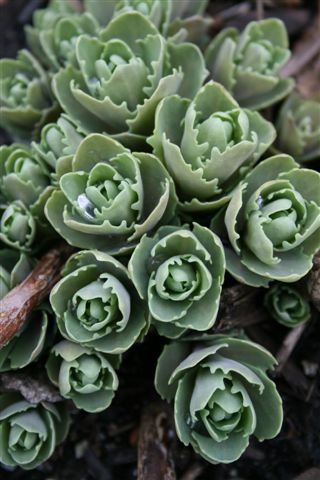
This emerging sedum is not a bloom, but the little rosettes almost look like blooms:
My Missouri currant (Ribes odoratum) is not quite in bloom yet. I wonder if it will tease me again this year with loads of flowers but next to no fruit?
I noticed today that the flowers of the male Skimmia are actually quite pretty, and dainty:
Although I originally bought the males to keep the females in berry:
The winter pink in this little sedum is so colourful, contrasting with the golden thyme, that it looks a bit like a bloom. In the summer, the sedum will be silver blue:
I love my Petasites frigidus, but I find the flowers which emerge before the leaves a bit creepy looking. When they get tall enough, I will cut them down, otherwise they will send seeds (which have little umbrellas like dandelion seeds) flying everywhere.
I hope Carol will forgive me - not only late, but also showing off my non-blooms, too.
Looking at other garden bloggers blooms, I am longing even more for Spring to arrive at last. All the best to everyone in their gardens this year!
I was happy to see a few signs of Spring. The weather is still very cold, for March, and the snow line is very low in the local mountains. Every year I have a crocus or two emerge from this corner of my garden, and I love the contrast of the cheery yellow against the dreariness of the fallen gunnera leaves:
This Winter Aconite (Eranthis) is smaller than I remember buying it last year, but it was delightful to find this tiny bloom peeking from my native/shade garden:
These mini irises are so cheery surrounding my granite bench. I hope they will naturalize and fill the area:
This emerging sedum is not a bloom, but the little rosettes almost look like blooms:
My Missouri currant (Ribes odoratum) is not quite in bloom yet. I wonder if it will tease me again this year with loads of flowers but next to no fruit?
I noticed today that the flowers of the male Skimmia are actually quite pretty, and dainty:
Although I originally bought the males to keep the females in berry:
The winter pink in this little sedum is so colourful, contrasting with the golden thyme, that it looks a bit like a bloom. In the summer, the sedum will be silver blue:
I love my Petasites frigidus, but I find the flowers which emerge before the leaves a bit creepy looking. When they get tall enough, I will cut them down, otherwise they will send seeds (which have little umbrellas like dandelion seeds) flying everywhere.
I hope Carol will forgive me - not only late, but also showing off my non-blooms, too.
Looking at other garden bloggers blooms, I am longing even more for Spring to arrive at last. All the best to everyone in their gardens this year!
Sunday, March 06, 2011
Another Plum Tree!
It was not a surprise, but it was wonderful that I could convince my husband and the kids to go pick up another plum tree this afternoon. I had my "landscaper" (who cuts my lawn, and does the occasional projects for me around the yard) dig a big hole just before Winter hit. But his idea of digging was to clear the layer of grass and soil, and leave a shallow "hole" of our near-undiggable clay. I suppose he would have used the excuse that he didn't want to leave a hole for the Winter.
It was me who came along after that, and actually dug and loosened up about 12" of the clay, and laid a load of grass clippings on top, to provide some organic material, before the Winter hit. Today, it was my husband who climbed in and dug a real proper hole.
It seems the grass clippings had some effect, since there were lots of worms in the top foot or so, which actually resembled something like soil. He removed that to the side of the hole. Below that it was grey clay. Thick, mucky, and non-draining. My husband removed a few wheelbarrows full of clay (dumping them just outside our fence, in the "abyss"), and mixed back the top layer of soil, with two large bags of planting soil (100 l or 4 cu ft each). I also poured in bonemeal. We had enough to plant the tree, but could use a couple more bags, to fill it up to the surface properly.
Enough about the dirt. What type of plum did we plant? It was a tough decision. I already have an Italian plum which is very tasty and sweet even when a bit firm. It has started to bear a good amount of fruit these past two years, for fresh eating. I wanted another plum which would also be good for eating, but also for making juice.
I phoned Triple Tree Nursery in Maple Ridge, where I have bought nearly all our fruit trees, and asked about their plum varieties. Their European plums included the Italian, Yellow Egg, Damson (not really for fresh eating), Toka and Superior. Their Japanese plums included Santa Rosa, Beauty, Shiro (Yellow), Methley and Satsuma. For flavour, Shiro and Methley were recommended.
Since then I read up on the various plum varieties, and the ones which emerged as the top choices were:
Methley (Japanese) - Red skin with dark red juicy flesh, early bearing, self-fertile, mild and sweet flavour, attractive and vigorous tree.
Green Gage (European) - Flavour was described as "exquisite", and my mom remembers her uncle (?) having this plum tree, green colour even when ripe.
Satsuma (Japanese) - Red with deep red flesh, semi freestone, good flavour.
I was really intrigued by the Green Gage, and might have tried it, except perhaps for some random notes on the internet from people who had bought some and were looking for recipes for them. It made me wonder, if they are so exquisitely flavoured, why would they not simply eat them, and not be looking for recipes? Not to mention, the photos of them really didn't do much for me.
So in the end, I decided on the Methley, for the dark colour (I like that in a plum, and it would be great for the juice!), hopefully the flavour, that it is an early bearer, and I hear that the Japanese trees tend to bear their first crop at an earlier age than the Europeans. The Methley trees available at Triple Tree (they are bare root, not potted up yet, so a great time to buy them!) looked pretty good, too. So the Methley joins our collection of one dozen young fruit trees.
The photo is courtesy of Marshalls Seed Co in the UK. In a couple of years, I hope to be sharing my own photos. :-)
It was me who came along after that, and actually dug and loosened up about 12" of the clay, and laid a load of grass clippings on top, to provide some organic material, before the Winter hit. Today, it was my husband who climbed in and dug a real proper hole.
It seems the grass clippings had some effect, since there were lots of worms in the top foot or so, which actually resembled something like soil. He removed that to the side of the hole. Below that it was grey clay. Thick, mucky, and non-draining. My husband removed a few wheelbarrows full of clay (dumping them just outside our fence, in the "abyss"), and mixed back the top layer of soil, with two large bags of planting soil (100 l or 4 cu ft each). I also poured in bonemeal. We had enough to plant the tree, but could use a couple more bags, to fill it up to the surface properly.
Enough about the dirt. What type of plum did we plant? It was a tough decision. I already have an Italian plum which is very tasty and sweet even when a bit firm. It has started to bear a good amount of fruit these past two years, for fresh eating. I wanted another plum which would also be good for eating, but also for making juice.
I phoned Triple Tree Nursery in Maple Ridge, where I have bought nearly all our fruit trees, and asked about their plum varieties. Their European plums included the Italian, Yellow Egg, Damson (not really for fresh eating), Toka and Superior. Their Japanese plums included Santa Rosa, Beauty, Shiro (Yellow), Methley and Satsuma. For flavour, Shiro and Methley were recommended.
Since then I read up on the various plum varieties, and the ones which emerged as the top choices were:
Methley (Japanese) - Red skin with dark red juicy flesh, early bearing, self-fertile, mild and sweet flavour, attractive and vigorous tree.
Green Gage (European) - Flavour was described as "exquisite", and my mom remembers her uncle (?) having this plum tree, green colour even when ripe.
Satsuma (Japanese) - Red with deep red flesh, semi freestone, good flavour.
I was really intrigued by the Green Gage, and might have tried it, except perhaps for some random notes on the internet from people who had bought some and were looking for recipes for them. It made me wonder, if they are so exquisitely flavoured, why would they not simply eat them, and not be looking for recipes? Not to mention, the photos of them really didn't do much for me.
So in the end, I decided on the Methley, for the dark colour (I like that in a plum, and it would be great for the juice!), hopefully the flavour, that it is an early bearer, and I hear that the Japanese trees tend to bear their first crop at an earlier age than the Europeans. The Methley trees available at Triple Tree (they are bare root, not potted up yet, so a great time to buy them!) looked pretty good, too. So the Methley joins our collection of one dozen young fruit trees.
The photo is courtesy of Marshalls Seed Co in the UK. In a couple of years, I hope to be sharing my own photos. :-)
Subscribe to:
Posts (Atom)